
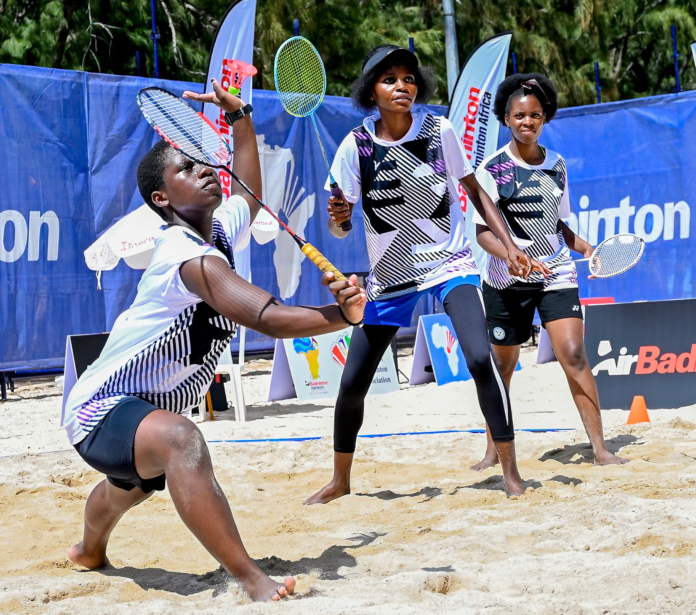
Hosting the Africa AirBadminton Championships in Uganda is one thing. Winning it on home soil is another.
For Uganda’s eight-player team, the return of the continental championship is therefore more than a homecoming. It is a test of whether the country can turn its early advantage in AirBadminton into sustained continental dominance.
Uganda enters the 2026 championship carrying the confidence of having won a previous continental edition in Mauritius. But the circumstances have changed considerably. The tournament has grown from four participating countries in Mauritius to nine in Ghana, and now to 14 nations in Uganda, with more than 120 participants expected.
AirBadminton is no longer simply an experimental outdoor version of badminton. Across Africa, more countries are beginning to understand its possibilities, and Uganda will have to prove that its previous success was the beginning of something bigger rather than a one-off achievement.
Uganda’s preparation has been built around an eight-player team four boys and four girls with the majority drawn from the squad that won gold in Mauritius, although there have been changes.
The players have spent about three months preparing, training at Mbogo High School under coach Kabindi. The preparation has also had to account for the unique demands of AirBadminton. Unlike traditional badminton, where players operate in a controlled indoor environment, AirBadminton introduces wind, sand and changing outdoor conditions into the contest.

That makes adaptability just as important as technical ability. And Uganda’s technical team is under no illusion that the previous title guarantees anything.
Other countries have had time to prepare. The competition has expanded, and nations arriving in Entebbe will not simply be making up the numbers.
Simon Mugabi, the CEO of Badminton Uganda, has stressed that Uganda cannot afford to rely on the success achieved in Mauritius. The championship is bigger; the field is wider, and the expectations around the hosts are higher.
The challenge, therefore, is not simply to defend a trophy. It is to defend Uganda’s credibility as one of the continent’s leading AirBadminton nations.
The team format adds another layer to Uganda’s challenge. With four boys and four girls, the selected players are expected to contribute across doubles and triples, meaning versatility becomes a valuable weapon.
Triples, in particular, change the rhythm of the game. With three players on court, communication, positioning and movement become critical, while the rule requiring teammates to alternate consecutive returns means players cannot simply rely on one dominant athlete to control every rally.
For Uganda, this could be an advantage because the team already has experience of the discipline at continental level. But familiarity alone will not win matches.
The players must manage the conditions, read the wind, protect their court positions and make quick tactical decisions. At Aero Beach, Entebbe, the environment itself becomes part of the contest.
The sand can affect movement and balance. The wind can alter the trajectory of the AirShuttle. And because there is no indoor roof shielding the players from the elements, conditions can change the way a match is played.
In AirBadminton, the surroundings are not merely a backdrop. They are part of the opponent. The choice of Aero Beach is also significant. The championship takes badminton outside the traditional indoor setting and places it in an environment where the sport can be seen, experienced and understood differently.
For Uganda, this fits the wider philosophy behind AirBadminton: taking the sport beyond the walls of conventional badminton facilities and making it possible to play on outdoor surfaces such as sand, grass and hard courts.
That could prove particularly important in Uganda. The country has had limited access to indoor badminton infrastructure, but AirBadminton offers a version of the sport that does not depend entirely on traditional indoor facilities.
Uganda has already experimented with the discipline through unofficial events, including activities on a hockey pitch and at Mbogo High School in 2023.
Now, the 2026 championship has been officially gazetted by the Badminton World Federation and the Badminton Confederation of Africa. That represents an important step from experimentation to structure.
The growth of the championship is perhaps the clearest indication of where AirBadminton is heading. The participating nations include countries such as Algeria, Tunisia, Nigeria, Egypt, Benin, Kenya, Rwanda, Burundi, Comoros, Zimbabwe and Zambia alongside Uganda.
The increase is not merely numerical. It means Ugandan players will encounter a broader range of playing styles and approaches, while other nations will also be gaining experience from competing against the defending champions.
The previous Ghana championship underlined how competitive the event can become. Egypt emerged victorious, with Nigeria finishing second, while Uganda was unable to qualify because of external circumstances.
That makes the 2026 tournament an opportunity for Uganda to re-establish itself at the top. But doing so at home comes with its own pressure.
The hosts are expected to perform, and every advantage knowledge of the environment, previous experience and preparation must be converted into results.
The championship itself is only part of Uganda’s AirBadminton Week.
Following the Africa AirBadminton Championships from September 16–19, Uganda will host the Zone 5 Regional Championships and a BWF/BCA AirBadminton Training Camp from September 20–22.
That extension is important because it gives the country something beyond medals.
It creates an opportunity for athletes, coaches and officials to gain more exposure to the discipline and build capacity around it.
The training camp also fits into the larger ambition of establishing AirBadminton as a meaningful part of badminton development rather than treating it as a temporary variation of the traditional game.
Badminton Uganda has been clear that AirBadminton is not intended to replace conventional badminton. Instead, it is another route into the sport.
A child who may never have access to an indoor badminton court can potentially encounter the game outdoors. A community without specialised infrastructure can have another way to participate. And players who already understand badminton can develop another set of tactical and physical skills.
That is where the long-term value of AirBadminton may lie. Use the championship to create a stronger foundation for AirBadminton beyond September.
The country has already been part of the discipline’s African journey from its early continental tournament in 2021. It has now returned to the continental spotlight with the biggest field yet.
The question is what happens after the final point.
If Uganda can combine competition with development, the championship could leave behind more than a winner. It could strengthen coaching, expand participation and give more Ugandans an opportunity to see badminton as a sport that does not have to be confined to four walls.
The AirShuttle will fly. The wind will test them. The sand will slow some movements and reward others. And somewhere between those conditions and the pressure of defending a continental crown, Uganda will discover whether its first AirBadminton success was a foundation or simply a moment.